
Water Damage Restoration Pricing Breakdown: What East Flatbush Homeowners Pay in 2026
In East Flatbush, a typical water damage restoration job runs between $4,500 and $14,000, with most basement claims landing around $7,800. The spread depends less on the square footage than on the water category and whether the contractor bills mitigation and reconstruction as separate phases. Get the estimate itemized by phase, and the final invoice rarely surprises you. If you’d rather not sort through the numbers yourself, call (518) 750-3137 and we’ll walk you through it.
The line the water left is where we start. Over the past 42 years serving Brooklyn, we’ve learned that the quote isn’t what confuses homeowners. It’s the gap between the quote and the final bill. Most estimates lump extraction, drying, and rebuild into one number. That single number hides the real cost structure, and it’s the reason two companies can quote $4,200 and $9,100 for the same basement.
What Actually Drives Water Damage Restoration Cost in East Flatbush
The baseline number every East Flatbush homeowner should know: water mitigation (extraction and drying) typically runs $3.50 to $7.00 per square foot in Brooklyn’s 2026 labor market. Reconstruction, when needed, adds $40 to $90 per square foot for the affected area. That’s the split insurers recognize, and it’s the split you should demand on any estimate.
Three factors move the price more than anything else:
- Water category. Category 1 (clean water from a supply line) costs the least to remediate. Category 2 (gray water from a washing machine or dishwasher overflow) requires antimicrobial treatment. Category 3 (black water from sewage or outside flooding) legally mandates full containment, removal of affected porous materials, and professional disinfection. Each category step adds 20% to 40% to the mitigation line.
- Affected materials. Water wicks up drywall, under vinyl plank flooring, and through the subfloor. A two-inch puddle in a finished East Flatbush basement often means removing the bottom two feet of drywall, pulling the flooring, and treating the sill plates.
- Drying time. East Flatbush summers run humid. Basements built in the 1940s and 1950s, common in this neighborhood, lack modern vapor barriers. Without adequate dehumidification, drying takes five to seven days instead of three to four. Equipment day-rates stack up.
We pulled a dehumidifier out of a house over by Remsen Avenue last month where the furnace room floor was a full inch underwater. The homeowner had called a handyman first. The handyman did a fine job sucking up the surface water but never opened the walls. Three weeks later, mold had climbed the studs and the repair bill doubled. That’s not a knock on handymen. It’s the difference between extraction and drying, which is the phase most homeowners never see.
The Three Phases Insurers Recognize (And You Should Too)
Every water damage claim in New York, whether it’s a basement near Kings Highway or a top-floor bathroom off Church Avenue, follows the same three-phase structure. Insurance adjusters use it. Xactimate, the estimating software nearly every carrier accepts, organizes all line items under it. If your contractor can’t or won’t break the estimate into these three phases, ask why.
Phase 1: Extraction and Mitigation
Typical East Flatbush range: $1,200 to $3,800
This is the emergency phase. Technicians remove standing water, haul out saturated materials, set up containment if needed, and treat affected surfaces. Line items include truck-mounted extraction, portable extraction units, content manipulation (moving furniture), disposal of unsalvageable materials, and the labor to cut out wet drywall and pull up flooring.
In East Flatbush, where many homes sit on high water tables, extraction rates run slightly above the national average due to tighter access in attached row houses and older basements with low ceiling clearance. Expect a minimum service charge of $600 to $900 even for small jobs. That covers dispatch, equipment load-in, and the first hour of labor.
Phase 2: Drying and Monitoring
Typical East Flatbush range: $900 to $3,200
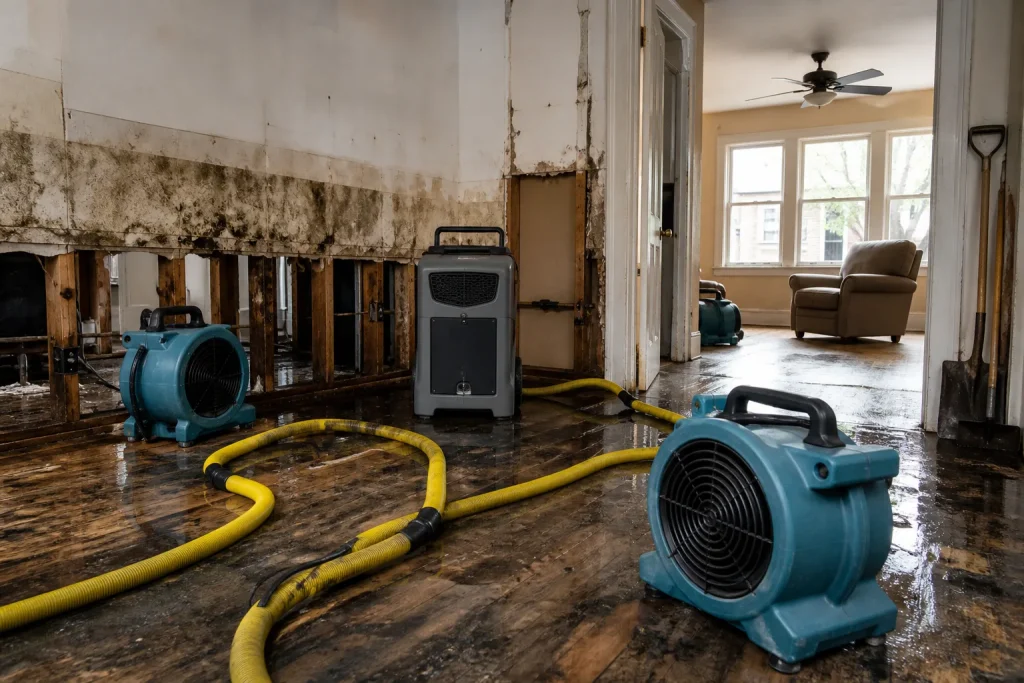
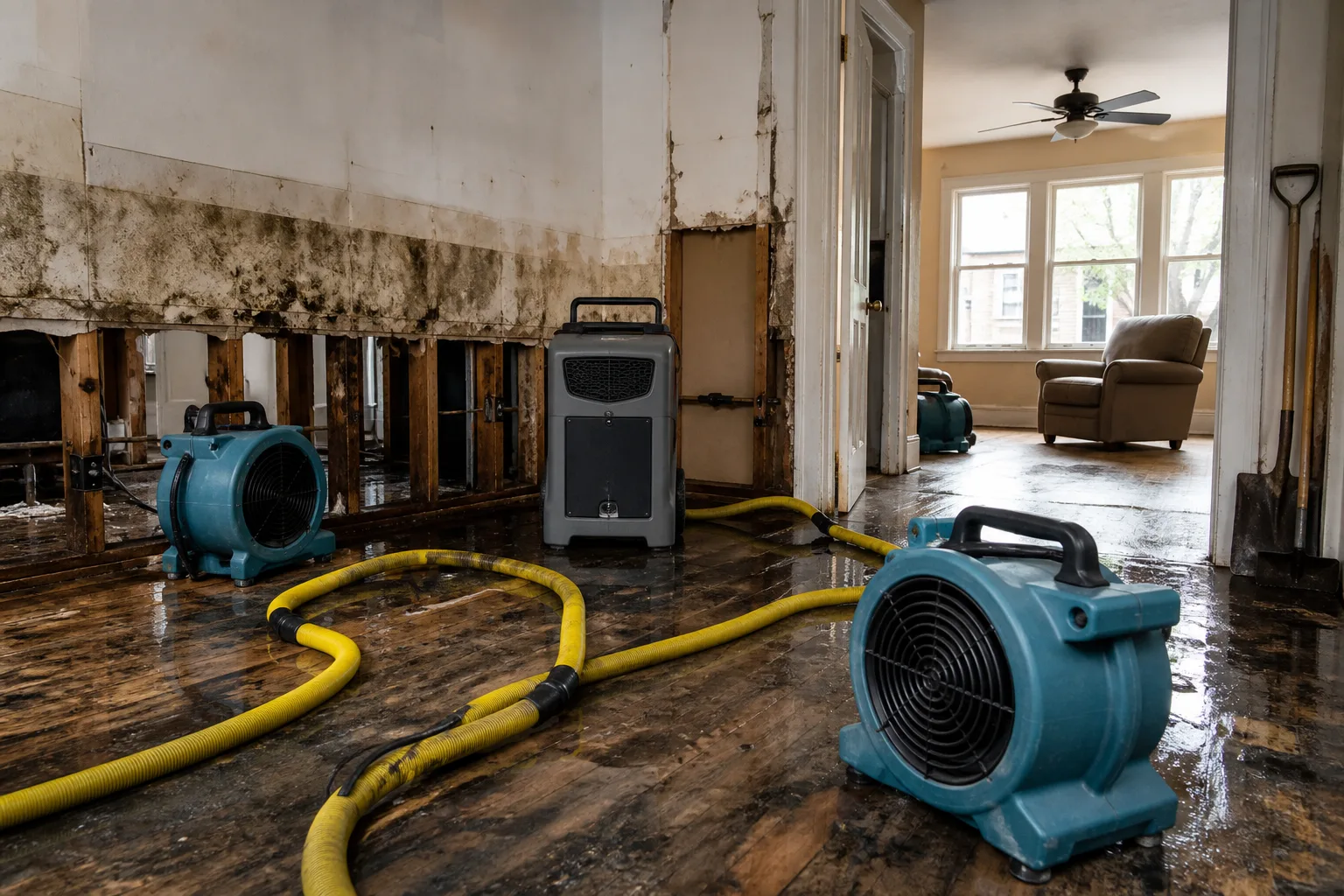
Once standing water is gone, the real work begins. Drying equipment gets placed based on a moisture map, not guesswork. Professional-grade air movers (we use B-Air and XPOWER units), dehumidifiers (Dri-Eaz and Phoenix are the two we trust), and Injectidry systems for wall cavities run 24 hours a day until the structure hits the dry standard.
Daily readings get logged. The same crew that placed equipment on day one returns to take moisture readings from the same spots, every day, until the numbers stabilize. That moisture log becomes the proof your carrier needs to close the claim and release reconstruction funds.
Day-rates matter here. In Brooklyn, an air mover rents at $36 to $48 per unit per day, a full-size dehumidifier at $75 to $110 per day. A standard finished basement might need ten air movers and two dehumidifiers. That’s $500 to $700 per day in equipment alone. If drying drags past seven days because the company under-sized the gear, you pay for it. Ask up front how many air movers and dehumidifiers they plan to place per 100 square feet.
Phase 3: Reconstruction
Typical East Flatbush range: $2,500 to $9,000+
Rebuild is where estimates diverge the most. Insulation replacement, new drywall, taping and mudding, paint, baseboards, and flooring all carry different rates depending on material grade and the contractor’s overhead. Some restoration companies hand this phase to a subcontractor. The subcontractor marks up. Your invoice grows.
We keep rebuild in-house with the same crew that ran extraction. The person who removed wet drywall in March knows exactly where the studs sit and how the baseboard was trimmed. No re-measuring, no re-explaining, no markup from a third party.
The $2,500 figure buys a basic unfinished basement job: new insulation, drywall repair, and a coat of paint. The $9,000 figure covers a finished basement with laminate flooring, custom trim, and bathroom fixtures. East Flatbush homes with original parquet floors or detailed plasterwork will land higher because those materials require matching, not just replacement.
Xactimate and Why Itemized Estimates Protect You
Xactimate is the software most insurance carriers and restoration companies in New York use to build estimates. It assigns a specific line item and a specific rate to every task: “Remove and dispose of drywall, average height, per SF,” “Place and monitor dehumidifier, per day,” “Apply antimicrobial agent, per SF.”
A lump-sum estimate of $7,400 tells you nothing. An Xactimate estimate shows 22 line items with quantities and unit rates. You can check whether the company billed for 300 square feet of drywall when only 200 square feet came out. You can see if the day-rate on dehumidifiers matches what they quoted verbally.
Here’s what we tell homeowners in East Flatbush, whether they hire us or someone else: request a copy of the Xactimate estimate before signing anything. If the contractor won’t provide it, move on. Any legitimate restoration company runs Xactimate. It’s the industry standard for a reason.
The most common hidden charges in Brooklyn restoration contracts include:
- Mold protocol upgrades. A company quotes standard drying, then after demolition discovers what they call “possible mold growth” and upgrades to full mold remediation. The upgrade adds $2,000 to $5,000. Sometimes legitimate, sometimes not. The honest version includes a clear trigger: we stop work, document what we found, and show you before proceeding. For more detail, see our Mold Remediation in East Flatbush page.
- HEPA air scrubber day-rates. Scrubbers run $95 to $160 per day in Brooklyn and get billed per unit. A company placing two scrubbers for ten days adds $1,900 to $3,200 to the drying phase. Necessary for category 3 water. Questionable for category 1.
- NYC permit fees. Structural repairs in New York City often require Department of Buildings permits. That’s $200 to $500 depending on scope. If an estimate excludes permits and the job requires them, the cost lands on you, not the insurance carrier, unless the contractor flagged it up front.
Floodline Restoration Co. provides no-hassle upfront pricing with direct insurance billing. The estimate you approve is the estimate you pay. If we find something unexpected behind the wall, we stop, we show you, we document it, and we get written agreement before proceeding. The 90-Day Done Right Promise, our Keystone Standard, is in your hands before we start. If it’s not done right, we make it right. No paperwork battles, no arguing.
Category 1 vs. Category 3: Why the Same Puddle Costs Twice as Much
Water category drives legal obligations. A contractor cannot legally treat category 3 water with category 1 procedures. Here’s how the three categories affect East Flatbush restoration pricing:
Category 1 (Clean Water): Supply line leaks, tub overflows, sink overflows. Water from a potable source. Mitigation cost: $3.50 to $5.00 per square foot. Drying equipment still needed, but no containment, no full material removal. Carpet can often be saved if extracted within 24 hours.
Category 2 (Gray Water): Washing machine discharge, dishwasher overflow, sump pump failure with minor contamination. Contains biological or chemical contaminants. Mitigation cost: $5.00 to $7.50 per square foot. Requires antimicrobial treatment, removal of carpet pad, and extended drying with sanitizer application.
Category 3 (Black Water): Sewage backup, rising floodwater from outside, any water that has passed through soil. East Flatbush sees a steady stream of category 3 calls during heavy spring rain when the combined sewer system backs up into basements. Mitigation cost: $8.00 to $12.00 per square foot. Full containment, HEPA filtration, removal of all porous materials including drywall, insulation, and carpet. Non-porous surfaces require cleaning and disinfection.
IICRC standards, which our technicians train to, set the minimum requirements for each category. RIA and IFA certifications cover the drying science and insurance documentation side. A contractor cutting corners on category 3 is creating a health hazard and a future legal problem. If someone quotes you $2,800 for a sewage backup in a finished East Flatbush basement, the quote is not honest.
Direct Insurance Billing: The Difference Between a Square Deal and a Runaround
Here’s a scenario we see regularly in East Flatbush: a homeowner gets a quote of $6,800 from a company that doesn’t bill insurance. The homeowner pays out of pocket, submits the claim themselves, and waits 30 to 60 days for reimbursement. The carrier disputes line items. The homeowner is now the middleman between the contractor and the adjuster, trying to negotiate rates they don’t fully understand and documentation they can’t produce.
A company that bills the carrier directly changes the entire dynamic. The estimate goes straight to the adjuster in Xactimate format. The moisture log, the photos, the daily readings all get submitted by the people who produced them. The carrier pays the contractor directly, less the homeowner’s deductible. The homeowner reviews one document and signs.
Floodline Restoration Co. bills the carrier directly on every job. We document everything: before photos, during-work photos, moisture readings, dry logs, and the final scope. You never play messenger between us and the carrier. That’s part of standing behind the work, not just the work itself.
We’ve also seen homeowners choose a lower quote from a company that doesn’t handle insurance, only to discover after the fact that the carrier would have paid for services the homeowner never knew to claim. Emergency service calls, temporary repairs, content cleaning, even dry cleaning for affected clothing: all covered under most policies when documented properly. A restoration company that knows how to bill insurance claims those line items for you. A company that doesn’t, leaves the money with the carrier.
When to Call a Pro
Water sitting in a finished basement for more than 24 hours is a problem that grows. Mold starts on damp drywall within 48 to 72 hours in Brooklyn humidity. Wood framing begins absorbing water immediately, and the longer it sits, the more it swells, warps, and weakens.
Call a professional restoration company if the water covers more than a few square feet, has touched drywall or flooring, came from sewage or outside flooding, or has been sitting for more than a day. A water damage restoration contractor is different from a general handyman: the contractor has extraction equipment, professional-grade drying gear, moisture meters, and the documentation discipline your insurance carrier requires.
Curt Bowman founded Floodline Restoration Co. in 2010 around a dispatch board, not a sales desk. Calls get answered by a live person 24/7. A credentialed technician reaches your East Flatbush home, extraction starts the same visit, and the same crew handles every phase from first extraction to finished rebuild. You can read more about our full process on the Water Damage Restoration in East Flatbush page, or see how we handle related emergencies on the Fire & Smoke Damage Restoration in East Flatbush page. If water is still flowing, priorities are simple: turn off your water supply, move any furniture you safely can, and call us. We’ll be there when we say.
The Bottom Line
Water damage restoration in East Flatbush runs $4,500 to $14,000 in 2026, with most finished basement claims landing between $6,500 and $9,500. The final bill depends on three things you control: the water category, how fast the drying starts, and whether you require an itemized Xactimate estimate before work begins.
Get the estimate in writing. Get it broken out by phase. Ask whether the company bills insurance directly. And don’t let a low lump-sum number convince you that corners aren’t being cut. The cheapest quote on a category 3 job in East Flatbush is usually the most expensive bill you’ll ever fight.
If you’re in East Flatbush and need help, Floodline Restoration Co. offers free estimates. Call (518) 750-3137 and a live person answers, day or night. We’ll walk the line the water left, explain exactly what needs to happen, and put the number in writing before any work begins. For more about how we operate, visit the Floodline Restoration Co. home page. A square deal: no surprises on the bill.
Frequently Asked Questions
Most East Flatbush water damage restoration jobs cost between $4,500 and $14,000, with finished basement claims averaging $6,500 to $9,500. The price depends on water category, affected square footage, and whether reconstruction is required. Call (518) 750-3137 for an exact quote. Estimates are free.
Most East Flatbush homeowner policies cover sudden and accidental water damage from burst pipes, appliance failures, and sewage backups when the water wasn’t caused by negligence or neglect. Gradual leaks and long-term seepage typically get denied. A company that bills insurance directly saves you the out-of-pocket delay and dispute process. Floodline Restoration Co. bills the carrier directly on every job.
A live dispatcher answers the phone 24/7 at Floodline Restoration Co., and a certified crew reaches the job the same visit. Extraction equipment starts running before the first hour is up on most East Flatbush calls. Speed on mitigation matters because mold starts within 48 to 72 hours in Brooklyn humidity.
If water touched drywall, flooring, or insulation, or sat for more than 24 hours, you need professional drying with moisture-mapped equipment, not a fan in the doorway and hope. A shop-vac removes standing water but leaves moisture inside wall cavities, where mold grows unseen. The honest answer for small puddles on concrete: clean it up and monitor it. For anything bigger in East Flatbush, call (518) 750-3137.
Written by Curt Bowman, Owner at Floodline Restoration Co., serving East Flatbush since 2010.
Need Damage Restoration Help?
Call Floodline Restoration Co. - licensed & insured, here with fast after-hours help in East Flatbush.
(518) 750-3137